Case · Portfolio & Asset Management

89 properties — one capital-allocation pipeline

A portfolio of this scale cannot be managed through traditional scaffold-based inspections. It is operationally impossible: one inspection round would cost ~50M DKK and only gives a snapshot. Instead, the system produces the basis for allocating CAPEX across all 89 assets — in the same unit of measure, every year.

  • Portfolio
  • 89 properties
  • 150 buildings

Headline numbers

89

Residential properties

150 buildings

~99M DKK

CAPEX freed up

vs. full replacement

~4,900

Roof damages registered

Individual damage lines

~30.4M DKK

M7 deferred capital

Reactive exposure

~85%

CO₂ vs. replacement

At portfolio level

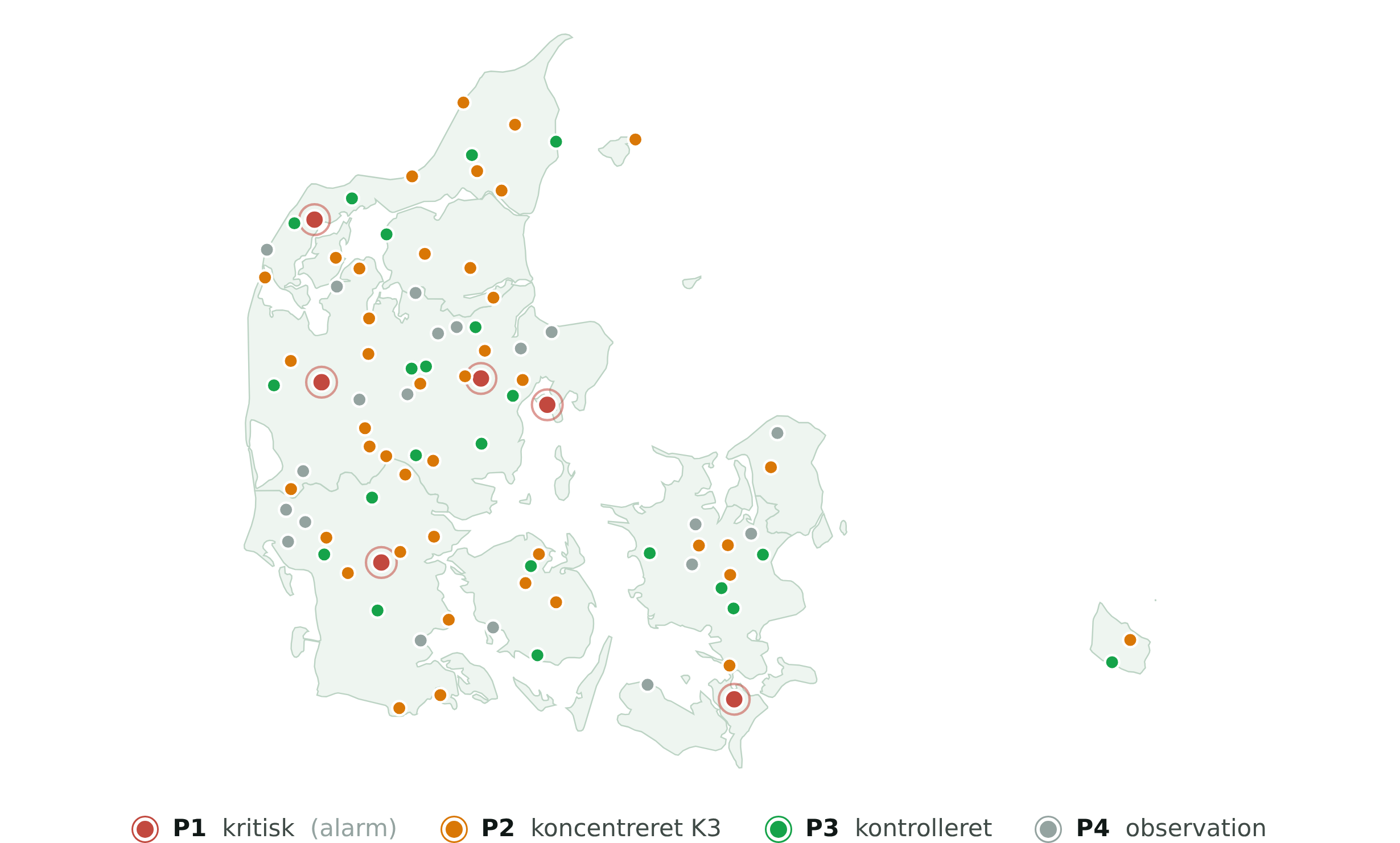
Map of Denmark showing the 89 portfolio properties
Portfolio · 89 properties · 150 buildings

The simple story — it’s not a construction project, it’s capital allocation

The asset manager has to choose: where do the CAPEX kroner make the biggest difference over the next 12 months — across all 89 assets, in the same unit of measure. The system already prioritized the portfolio — the manager only approves the allocation.

89 properties × 4 key figures × hundreds of data points per annual cycle, delivered in one consolidated report — not 89 separate engineering reports in different formats. The asset-management meeting spends ~90 minutes reviewing them.

The scaffolding equation

“Half of the 15-year CAPEX saving would go just to get permission to see the roof.”

A full scaffold-inspection round of all 89 properties costs ~50M DKK — and gives a snapshot every 5–10 years. Drone monitoring costs ~0.6–1.0M DKK/year and gives continuous, uniform data on the whole portfolio. It’s not a cost difference. It’s a structural difference.

F1 vs F2 — CAPEX allocation

The system sets targeted maintenance (F1) against full replacement (F2) for the whole portfolio. The difference is the capital the asset manager can deploy freely — instead of tying it up in roofing.

~99M DKK

CAPEX allocation (76%) — capital not tied up in roofing, but available for energy measures, optionality and portfolio growth.

~130.3M DKKF2 — full replacement (AE price)
~31.2M DKKF1 — targeted maintenance, year 1 (AE price)

P1–P4 prioritization — the CAPEX kroner ranked

Capital-allocation matrix · 1st drone round (21 properties)

The system ranks each property by condition and K3 concentration.

TierShareCriterionYear-1 budgetTotal K3Properties
P1 — Critical~31%Condition ≤ 43 (±25)7.6M DKK3396
P2 — Concentrated K3~38%K3 ≥ 50 regardless of condition8.4M DKK7077
P3 — Controlled~20%K3 < 50 + condition 24.9M DKK1624
P4 — Observation~11%Condition 1 + low K32.7M DKKminimal4

AE · Molio dual price matrix — two comparable prices, per damage line

We produce both an internally calibrated AE price and Molio’s official list price per damage. The ratio of 0.85 tells the asset manager that the portfolio is conservatively priced — if a tender comes in at 0.80–1.00 of the AE price, it’s within expectations.

ItemAE priceMolio priceRatio
F1 portfolio maintenance (year 1)~31.2M~36.8M0.85
F2 portfolio replacement~130.3M~153.3M0.85
F1 total over 15 years~64–71M~76–84M0.85
Capital preserved, 15 years~59–66M~70–78M

No consulting engineer delivers that dual-price benchmark. It requires calibration across 2,000+ buildings plus access to the Molio pricebook and automated element to Molio-code mapping. The engine does it per damage line × 4,900 damages.

Get Started

Want your portfolio on the same basis?

Let us quantify the whole portfolio. One drone-round gives one consolidated report with CAPEX prioritization on the same scale for all properties.

Request a Meeting